
§ Intro ^
I love this series. The last time I saw it was with a woman I was dating, which is probably the best way to watch it.
The experimental, surreal, campy, and just plain silly elements can be a little hard to parse if you get too caught up in figuring them out. Just relax and give the show time to grow on you --- you'll come to understand it on a vibrational level, if not a literal one. Then you can ponder the details afterwards and on rewatches.
As for this document, it's a messy, lightly edited mishmash of notes and analysis and whatnot.
§ New translation ^
I watched a recent fansub which is written from a nonbinary perspective. I vaguely recall the translation(s) I watched before having some awkward/confusing moments (like most anime). This one felt completely natural.
Things that stood out:
- "-sama" is translated as "Master", which is a bold choice but it works. I can understand why they're controversial, but I lean toward approving of these sorts of localizations. Just because I recognize the honorifics doesn't mean I understand all the connotations; also, I can still hear the honorific just fine, so the localization provides an additional perspective and doesn't take anything away. (I do find it weirdly irritating how they put the names into Western order though. I've always found it jarring to have two words just switch places. Subs basically always do that, unfortunately.)
- Utena says "dude" sometimes. It feels perfectly natural and in character.
- The fuck word is used.
- I feel like I can lean in harder to interpreting the show feeling confident that I won't get hung up by a bad translation; when it sounds weird in English I know it's supposed to.
A cool thing about this fansub is there's a page for each episode with notes on translation decisions and the analysis of the series' themes that informed them. Apparently Utena uses masculine terms to refer to herself/themself which usually gets lost in translation.
Look dude. Despite how I seem, I'm just a normal girl.
I really wanted to preserve the hilarious contradiction present in the Japanese where Utena is saying they're a normal girl while still using boku. They've got one foot on the accelerator and one foot on the brake of their gender with this line --- ending it in a feminine なの particle.
§ Should I follow Haru's lead and they/them Utena? ^
I'm not sure! The first-person pronoun thing seems like pretty compelling evidence of Utena's identity, but I'm also not Japanese, and women sometimes do it too. Is "Girl" in the title meant to be read slyly? For a series that is so pro-queer it seems kind of weird to misgender the lead like that. I guess Wandering Son did it.
Utena ... is signifying her rebellion against traditional feminine gender roles with her use of 僕 (boku), but as part of this rebellion, she necessarily must still be a girl. Rather than saying "girls don't use boku, so I'm not a girl", her pronoun choice is saying "your conception of femininity is bullshit, girls can use boku too".
--- Haru Dipthong: Gendered Pronouns in Japanese vs. English
Several people have asked me if I've heard of ぼくっこ (bokukko, a girl who uses boku), and have said that Utena is a prime example of one. I could not disagree more vehemently. To say so is to wildly miss the point of the series. Utena is protrayed as fitting in this trope to begin with, sure, but that is only to make the commentary on their gender so much more poignant. It's putting Utena's gender in a box when the series shows how they revolutionise the world by refusing to conform to a box. It's oversimplifying and ignoring the quite overt nonbinary themes and messaging. If you think you understand Utena's gender as "just bokukko", you have missed so much of what the show has been trying to say.
It's clear that gender is a huge part of the show, so interpreting Utena as nonbinary makes total sense to me. I mean, come on, it's right there in the title sequence!
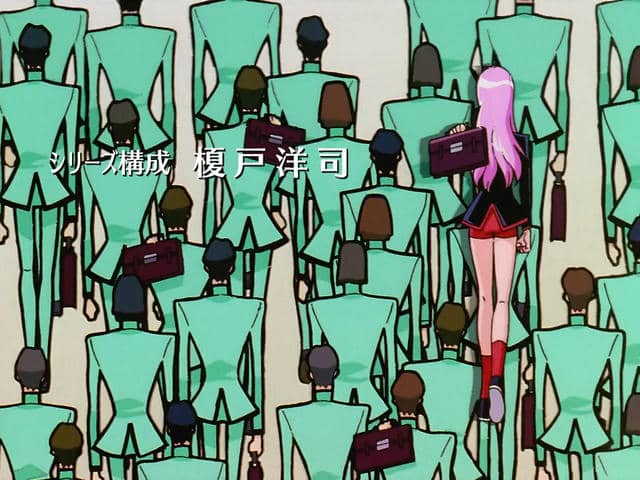
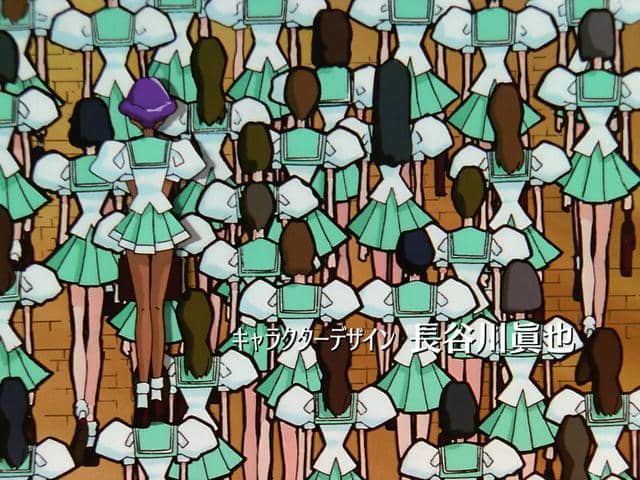
One of my favorite parts --- and perhaps the strongest evidence for a gender-first reading --- is when Utena gets depressed and starts dressing like a girl and Wakaba is horrified and snaps them out of it. And The Prince is clearly not just a role model for Utena --- wanting to be like him is central to their character! (They do seem to think they might have romantic feelings for him, but it's not at all uncommon for people to have difficulty separating "be you" from "fuck you" pre-transition.)
But gender isn't cleanly separable from sexual identity. Being gay is as much as violation of gender norms as transitioning, and of course it's also common for cis queer people to violate gender norms in other ways. Whether we read Utena as trans or a queer cis woman seems pretty arbitrary. Gendery stuff can be part of the queerness package or not --- it's up to the individual.
I think I'm gonna "they" them, though.
What I tried for Utena was to start by having her say "I'm going to become a prince." I made her a person who herself is aware that her character is occupying a masculine position in the story. Although, at some point she finds herself in a feminine position (laugh). ... And therefore, she faces trials as a prince over and over again.
--- Ikuhara
We entrusted her with showing the nature of humans to defy their own instincts and norms, because that brilliance is what we wanted to depict.
--- Enokido
§ It takes a little while to really get going, but... ^
...it's queer as hell immediately. Utena is introduced getting in trouble for dressing like a boy and being studly as hell while all the girls swoon over them.
And there's one of the iconic duel scenes in the first episode. With that awesome choral rock song. The music in this show is so good.
§ Everyone treats Anthy like shit because she's the only Indian girl at her school ^
That has to be why, right? How else are we to interpret a bunch of people bullying and even slapping her in the face for no reason, when hers is noticeably the only skin darker than mayonnaise and she's the only one wearing a bindi?
It's nice to have a character with darker skin who isn't a horrible racist caricature. Anime can be pretty regressive. Anyway, I love Anthy.
§ Miki ^
§ Does Miki want to bang his sister? ^
Miki has a crush on Anthy. Because... she reminds him of his sister.
Huh?
He feels really guilty about missing a piano recital when he had the measles, because his sister panicked and then stopped playing due to his absence.
Uh... what? I know people blame themselves for things that aren't their fault, but like... that's pretty weird! What if he really feels guilty about something else...?
He runs into her right after she hooked up with Touga and their whole interaction is Weird. And then Touga says something about seizing what you want.
She also mentions receiving a love letter about her piano playing, but not from whom. Then in episode 6:
Miki: Sibling relationships are complicated.
Nanami: Just what does that mean?
Miki: coughs, changes the subject
Yeah, I think he wants to bang his sister.
Although... later, Kozue tries to kiss him, which alarms him. It seems like she knows --- or thinks --- he's in love with her, and goes out with fuckboys to try to keep him at a distance, but also is secretly in love with him? Or is trying to make him jealous? Does Miki's response to the kiss attempt mean he doesn't wanna bang her? Or maybe he doesn't want to make their feelings overt? Or he just doesn't want to do it in public. Later, Miki carries Kozue due an injury, and she presses up against him and he complains.
I guess Kozue pushed his music teacher down the stairs because he got handsy with him? The scene about that is very interesting, it kind of seemed like she had done this before and recognized by his facial expression what was going on. Or maybe she was just reading into it, the teacher was fine, and she's being jealous/overprotective. In any case, it seems like childhood abuse plays a significant role in their relationship. In episode 26, we learn they are estranged from their parents, Kozue much more than Miki. During the council, Miki says "I don't trust adults who say something is for my own good. ... If it means being exploited by an adult for their own gain, I will no longer duel."
They both take a ride with Akio and Miki has a spinning rose scene where he imagines himself as Akio and Kozue as Anthy, then they cut to what I can only describe as a sex fake-out: we see them from the shoulders up, facing each other. (Ultimately they are revealed to be putting up a birdhouse.)
Kozue: Hey, a bit gentler.
Miki: Sorry, I moved it.
Miki duels Utena with Kozue as his bride, and she pulls the sword out of him, which I took to represent Utena and Anthy's relationship going to the next level when they switched sword-sources. Kozue tries to make out with Anthy, which distracts Miki.
The Sword of Dios comes from the Rose Bride Anthy's idealized fantasy of the Prince.
Thus the Sword of Dios that Saionji and Utena drew out of Anthy in the previous episodes was something originally pulled from Akio.
But somewhere deep within Anthy, she has unknowingly started seeing Utena as a Prince. That's why Akio's Sword of Dios disappears and "Utena's Sword of Dios" manifests.--- Enokido
§ Is Miki a girl? ^
The last time I watched this, I interpreted it like Miki is obsessed with Kozue because she's literally the girl version of "him". (Which would not necessarily preclude wanting to bang her.) That reading would fit with this storyline where Miki's doing patriarchy shit (trying to win Anthy in a duel) despite it clearly not being her thing (I guess to try to protect Anthy from Touga?). Miki faced a dilemma --- duel or don't duel --- and decided to go with the option society said to pick instead of asking Anthy how she felt, then realized mid-swing it was a terrible mistake.
This would also explain the significance of Miki and Kozue's initial falling out. Kozue forced Miki into a "big brother" role of reassuring her, which Miki then failed to perform. (Why would you blame yourself for being ill? Almost like blaming yourself for other things outside your control, like your gender.) Hence why it was so traumatic and looms so large in Miki's psyche: it's the dividing line where gender intruded into their life in a big way. Before that they were siblings, but after they were brother and sister. The "something eternal" Miki wants back and seeks through the piano song is that place of comfort and safety in childhood, before gender ruined their lives and she became a boy. (I don't think Miki actually understands any of this, though.)
Kozue seems to play "big sister" to "little sister" Miki after Miki failed to be the "big brother" --- Kozue is doing Miki's eyebrows in the movie's bath scene. The parents Kozue hates but Miki doesn't could be less a result of childhood abuse and more a result of their not accepting Miki's gender (plus Miki being a doormat/egg).
And check out the Saturn game's art.
§ There is so much incest ^
Miki/Kozue, Nanami/Touga, Anthy/Akio
Why is there so much incest in anime?
Akio is also fucking his fiancee's mom which... feels like incest. I guess he's fucking everybody, though.
I'm often been asked why so many brother-and-sister relationships appear in this work. Well, it's mainly because it's a taboo sexual behaviour.
--- Enokido
§ What does it meeeeeean? ^
§ What does Miki's stopwatch represent? ^
It's a rhythmic element used to punctuate scenes, but is there any deeper meaning here?
It seems that Miki is taking a measure of the other characters, holding themself apart as a judge and observer rather than participant. This would fit neatly with the trans reading, with Miki constantly measuring her social role to make sure she's performing gender correctly.
It also might just refer to how Miki is the only Student Council member who is relatively nice and normal and not a conniving creep, and hence acts as a "straight man" barometer for the others.
Nanami actually asks Miki about it and Miki is evasive. Perhaps it's nothing more than a running joke.
§ What do the spinning roses represent? ^
Roses are synonymous with romantic love (at least in the west). They're also a staple of visual euphemism for vulva. And the sapphic genre Utena exists in is called "yuri", which literally means lily; lilies look very different from roses, but, you know, flower. So at first blush, "roses = gay" isn't much of a stretch, but the way they're used is subtler than that.
Sometimes the roses obviously represent love or attraction. Sometimes, it's more like they mean magic, or perhaps drama. Sometimes they indicate a scene is a memory. As the show goes on, you get a feel for them, but it's still hard to find a definition.
There's a very interesting part in one of the early duels --- maybe the first one? --- where Utena channels The Prince's spirit. When his form crosses into theirs, they're obscured by a spinning rose, then Utena magically wins the duel. The way the rose is used here feels like censorship of a sexual encounter! (It might just be a really low-budget way to indicate some magic shit is happening.)
While there is magic in the show, I don't tend to interpret it literally. The Power to Revolutionize the World seems like a metaphor for queer love and/or identity. So maybe it's correct to say that the roses represent magic, but the magic isn't literal.
There's also some fancy meta-textual type shit happening. Like, you get scenes with the roses where it seems like they indicate the story itself is magically acting on its participants, intervening mischievously to cause drama.
In episode 31, they seem to mean "now loading". They appear during the silent pauses between Touga/Akio making a pass at Nanami and her response.
Someone has catalogued them all. Their interpretation is that they "introduce a character, or a new aspect of them".
Users on Empty Movement had some very interesting things to say, in particular about how spinning is a core theme of the show: people trapped eternally repeating the same patterns (or fantasizing about spinning their wheels for eternity rather than move the fuck on); revolution-as-in-upheaval that might only be part of the routine revolution-as-in-cycle of history; endlessly turning gears cloaked in feminine livery.
Above all, they give a theatrical flair to scenes. Since they're superimposed on top of the video, they feel like a separate layer, a decorative frame on the camera lens or around the stage --- which reminds us to treat the events inside the frame like a performance, not reality.
§ The car is sex, right? ^
There's massive sexual energy in all the scenes where they're in it. Saionji takes a ride with them and Touga basically comes onto him, then Akio does a... handstand? representing his greater experience? Then Saionji says he's a changed man, he's seen things they wouldn't understand, etc., like he just lost his virginity. Then at the end of the episode it's made very clear that Touga and Akio are fucking.
Finally a metaphor that seems obvious and doesn't make me feel stupid!
Though it doesn't seem like everyone who takes a ride was literally fucking. More like being groomed with a night on the town. Being... taken for a ride.
§ Casanova goes fishing ^
The scene where the GOGAI GOGAI! girls go fishing has got to be the bluntest, least confusing example of Utena's feminism:
Sailor: I am the charming and chivalrous legendary sailor, Casanova! A fisherman playboy with no equal!
Fish: What a man!
Fish: He's so enchanting!
Fish: Boil me!
Fish: Roast me!
Fish: Fillet me!
Fish: Spread me out like sashimi!
Sailor: Hmph. All fish are the same. They only exist to be used by me.
I lol'd. Heterosexuality bad!
§ Okay, some other parts aren't that subtle either ^
Utena is bad at horseriding. Akio: "I think it feels quite nice, once you get used to it."
§ Black Roses ^
§ Episode 22 is confusing... ^
So the guy who Mikage is trying to turn into the new rose bride is named Mamiya. He has some illness which motivated all the research into "eternity". He doesn't look anything like his sister Tokiko --- who left the school and avoided its anti-entropic effects which have made Mikage an eternal high-schooler and kept Mamiya alive --- and instead looks more like the Rose Prince, Anthy, or Akio.
I thought Mikage was mega gay for Mamiya, but apparently he's actually in love with his sister? Who believes Mamiya is dead.
What was the deal with the blinking hand pointer? I liked it, but I was a little confused by its meaning. I guess it's just a cute experimental way to draw attention to details and mock the viewer. Some things it seemed to be pointing out:
- Time was already working differently, or at least it was perceived to be moving too quickly --- the single cat becoming two then three while the tea got too strong
- The preserved leaf and butterfly from the Seminarium elevator --- the eternity theme again
- The lipstick on the teacup --- I guess saying Mikage kept the teacup for sentimental reasons?
- One person in a crowd --- I have no idea who
There are symbols that often appear in the story that are unknown even to the scriptwriter. Just what on earth is this "finger icon"? (laugh)
--- Enokido
It seems that Akio and Mikage murdered the boys to cast the spell that pushed the school outside of time, or generated anti-entropic effects, or whatever. But Mamiya confesses to his sister that he did it.
The Rose Signet is the only symbolism that I feel I understood, maybe because Akio explicitly said it represents the contract between them. He puts one in the stained teacup, which represents the unobtainable object of Mikage's desire. Mikage puts it on when he decides to commit to the project despite the mass murder. I guess there's also a symbolic relationship to marriage.
§ ... but episode 23 clears up a lot! ^
Mamiya didn't look like his sister because Mikage was delusionally imagining him as Anthy. In fact, he did die, and it was Mikage who set the fire. The various symbols in the Seminarium are there to help Mikage exist in his delusional memory. The cult that brainwashed the previous duellists itself existed for Mikage to brainwash himself.
I think we finally understand what's been happening to the Black Rose Duellists, too. When Mikage is defeated, time gets rewritten so he never existed and the Seminarium was never built. This must be what happened to the other duellists --- the painful memories that drove them got erased from their timeline, which is why they became strangely absent or reverted versions of themselves. We see that in this episode when Wakaba re-enacts an early scene of almost pulling Utena out a window.
I had thought that the duellists were dying and the Seminarium was replacing them with doppelgangers or something. They show the bodies being burned. But actually I think those are supposed to be the bodies of the boys who were sacrificed --- each death powers one rewrite.
Did Tokiko actually come back to the school, or was that another of Mikage's hallucinations? He sees Utena as Tokiko and even calls them that.
It's also interesting that they didn't show Mikage pull his sword out of anybody. I suppose if he were going to, it would be out of Tokiko, right? Or maybe Mamiya, who only exists in his mind?
The ring-in-the-teacup symbolism is more interesting in retrospect. Mikage decided to commit a crime for the sake of his love, but it was self-defeating. His deal with the devil pushed Tokiko away and failed to save Mamiya.
Akio says at the end that Anthy, like Mikage, never existed, or maybe that she will soon have never existed.
§ Did Ruka die? ^
??? What the hell is his deal? It sort of seems like he played Shiori in order to get Juri over her? (She really seems like a horrible piece of shit who will never return Juri's love.) If so, he didn't do it out of genuine concern for Juri, given that he also sexually assaulted and harassed her. What a strange character to appear so briefly! I thought at first he was the guy from their past, which would have made more sense, but no.
§ This series has the BEST... clip shows? ^
There's a clip show capping each arc, way more than I would expect. But they make it easier to follow the story, and their quality is exceptional. They use different versions of scenes and include a framing story with real substance. If you skipped episode 33 when you saw it was a clip show, you would have missed a huge plot point: Utena being raped by Akio. This episode has got to be the pinnacle of the clip show form.
The first person POV at first seems like a 4th wall break joke, then becomes an intimate look at Utena's character, and is ultimately revealed to be the rather sickening view from a predator's perspective. Utena's discomfort with being away from Anthy is at first endearing, then concerning, then alarming. Recontextualized with the knowledge of who they're talking to and where, seemingly innocent vacation scenes look more like a hostage situation.
We don't see exactly what goes down when the deed is done, but we don't have to: we just saw fearless Utena slowly unravel into a panic attack. The first thing they say afterward is that they "didn't expect that to happen" --- the typical sort of downplaying you instinctively do when someone you trusted betrays you and you aren't quite sure of what you're feeling.
There are so many great details in this episode. Utena's monologuing to the camera emphasizes how one-sided the situation is --- Akio impassively observes them like a zoo animal and makes no effort to calm their nerves. The Go match that Utena suddenly loses in what seemed like a throwaway joke illustrates their youthful mind being handily outmatched by the adult's. And despite being such a heavy episode brimming with dread, it has fun moments, like Akio listening to the intermission girlies on the radio and talking to them on the phone.
I think this is actually one of the best episodes of the entire show! It's devastating. And, again: clip show.
§ Akio is SO GROSS ^
Utena being with Akio feels so wrong, but it's not just because he's a massive creep who's been grooming them (or because they really belong with Anthy) --- there's also a sense in which it feels as though they're betraying their own identity. It's like their strong personality has been scooped out and replaced by that of a demure pod person. They seem dissociated. It echoes both Anthy and the depressed Utena who dressed like a girl earlier in the show.
Juri: Looking at them now, I only see a girl.
Miki: What do you mean? Tenjou-senpai is a girl.
Juri: I know that. It's just...
Miki: I know. I see it too.
§ Utena is bi ^
While the only significant relationship Utena has with a man in the series is a toxic and predatory one, they are actually attracted to him. It's clearly textual and can't be shrugged off like the enby reading. Bisexual non-women, in my lesbian classic!?
Actually, pretty much everyone is bi. And in love with Utena.
§ Is Utena really not physically attracted to Anthy, or just useless? ^
Juri: What are you going to do with Anthy? You like her, don't you?
Utena: I think we mean something different when we say "I like her". For me, it's an innocent kind of-- Sorry, I'm not saying your feelings aren't innocent, but...
Either way, I don't... Himemiya is just... She's just so...
They're obviously in love. And Utena is confused about their feelings all the time.
They are clearly attracted to each other in the movie (they even kiss!).
§ The ending is super frustrating!?! ^
At the end of the day, I think the main theme in Utena is "frustration." ... I think the reason that Utena has remained in everyone's hearts is because this "frustration" is at the center of it. If it had told a story of success, everyone would have forgotten about it quite quickly.
--- Ikuhara
What even happened? I guess it was a hopeful note, like Anthy grew a spine and is taking some initiative and chose Utena over Akio. But... Utena's missing? Did they survive and then do the sensible thing by running the fuck away? (That doesn't sound like Utena!)
Or maybe Anthy is actually going to an apartment they rented together?
Maybe it's something like how past duels seemingly rewrote history, but from what is actually said it sounds like some time has simply passed and people have moved on. Maybe Utena obtained the power to revolutionize the world and it's like a genie and they wished for them to be free? (It seems like the conventional reading is that Utena revolutionized the world of the school by making everyone's lives slightly better.)
Honestly, what's really revolutionary about her is that she isn't aware of her surroundings or her future, when suddenly, she enters a new phase of her life. She revolutionizes herself as well as the world around her. From now on, she's going to oppose and discover the world.
--- Ikuhara
The more I think about it, though, the more it grows on me. You would never expect a failure in that pivotal moment when Utena drops Anthy. But one of the big throughlines of the story is that dominant narratives about romance are bullshit, and it flips the script on the knight in the shining armor story without actually undercutting Utena's 'princeliness'. They could not be more wrong when they say that trying to be a prince was all just play-acting, and we can all see it. They did their best, and it isn't their fault they couldn't live up to an impossible ideal; that doesn't retroactively invalidate their identity. They don't rescue Anthy, but they do break through and encourage her to rescue herself.
Maybe she's a prince-as-illusion. Because Utena is a woman, one understands visually that she is a prince only as an illusion. And from the very beginning, all the characters realize that the prince is nothing more than a dream.
--- Ikuhara
Talk about a Pyrrhic victory, though! Utena pays for being a little bit of a dummy and becoming invested in romantic fables by getting stabbed in the belly by the very person they were trying to rescue. It's a triumphant ending for Anthy, but a humbling one for Utena. Love hurts!
So what I think is interesting is that while Utena is a woman, she is venturing into an essentially male "romance". I tried to translate that phrase "venturing into a romance" to "venturing into the world". I stipulated that until now, there had never been a girl venturing into the world, and through the stages of the story she becomes the first woman to discover "the end of the world". I tried to think of a story where, because she is the first to venture into the world, she is also the first to know that despair.
--- Ikuhara
Even though I knew there was no way she could win, I wanted her to fight to the bitter end.
Utena accepted everything about Anthy.
It is likely that as her Christ, she knew Anthy would deny her three times before the cock crowed.--- Enokido
§ The story as I understand it ^
Long ago, Akio was a great warrior who slayed dragons. The people he protected demanded too much of him and it took a toll. To protect him from the villagers, Anthy cast a spell which unstuck them from time. It made them immortal and doomed her to endlessly relive being stabbed to death protecting her brother.
Anthy could leave this at any time, but she chooses to continue to endure it for her brother, who expects it from her as part of a regimen of abuse. The endless torment of the villager's swords also represents the ongoing pain caused by his abuse, which it is both part of and facilitates. Akio wants her to stay in her place so that he can access superpowers hidden behind a locked door.
In order to get into the door, he needs a powerful sword. He has already tried many of these, which break when he tries to cut the door open. These swords are summoned from the chests of duellists --- would-be rescuers/owners of Anthy. The more you care about someone, the stronger the sword that person can summon from your chest, and the effect is heightened when the feeling is mutual. To this end, various fucked up rituals like the duels have been arranged by Akio to try to generate a powerful sword. Anthy has tried to numb herself against feeling anything for these people because she knows they will be used and then killed --- by her, if necessary --- and the swords that stab her also represent her pain associated with this: both the people she deprived herself of feeling for and the ones she cared about enough to scar her.
It's not clear what Akio wants with the power to revolutionize the world, or whether he even really wants it. He's satisfied with everything staying the way it is forever. If he ever cared about his sister, that is long past. He seems aware of what a bad person he has become and regrets it, but still expects her to be his sacrificial lamb forever, just so so he can enjoy himself at the top of the food pyramid. To maintain his position, he abuses her in many ways: by putting her through scenarios of play-acting at being someone else's slave, by sleeping with the people she cares about, and by sexually abusing her. (I suppose this could be consensual, but Akio systemically manipulates and exploits everyone around him and treats her like shit; while he has apparently gotten worse over time, one wonders if he was ever really a good person and when their relationship became incestuous.)
In any case, he can't get to it --- but Utena can, because they are a sincerely good person who actually loves Anthy. Utena's nobility of character --- their willingness to fight for the freedom of the one they love as their authentic self, in spite of constant setbacks and self-doubt --- lets them open Anthy's heart to her need to love herself, leave Akio, and let herself experience true love again.
§ The Movie ^
Utena with short hair! Utena in a stripey black uniform! Hell yeah! Utena with a silly hat! Uh, okay! Well, if anyone can pull it off...
Utena and Touga are exes in this continuity. I think they were together in the manga which everyone says is bad. Shiori is horrible to Juri because Shiori's boyfriend drowned saving her sister? But Touga was her boyfriend? And he was dead the whole time? Wat? ???
There's a huge Miki/Kozue moment: Kozue doing Miki's eyebrows while they're in the bath together. This both lends credence to the trans theory and suggests that they are fucking.
There's already a kiss in the first duel! And then Utena actually got pretty damn forward with her in their room afterwards... until Anthy went into "I am your servant" mode and creeped them out. I can't tell if Utena is uncomfortable with the idea that Anthy sleeps with her betrothed due to the sex slavery aspect, because they're jealous at the thought of her with someone else, just general discomfort with sex, or because it makes it hard to tell if Anthy is genuinely interested. Maybe a little from each column.
The ending is very different --- Utena turns into a car! --- but it has the same theme as my interpretation of the original ending. Anthy literally rides Utena to freedom. Even though it's so much weirder, it's also more satisfying because it ends with a passionate kiss. Actually, one of the best things about this movie is that they are explicitly into each other from the beginning. They even paint each other naked!
It's so surreal. I love all the weird architecture and strange machinery. Another great thing about it is that piece of shit Akio literally dies of shame after raping Anthy.
Between this and the TV series, it's quite satisfying, but I think either one of them on its own would feel a bit lacking. The movie is gorgeous and excellent but it's pretty short, while the TV series gestures at a happily-ever-after (or a happily-sometimes-later) but leaves it off-screen, and they never so much as kiss. (Although, to be fair, the scenes where they fall asleep gazing at each other and holding hands is like a million times more romantic.)
Well no, I'm often told that, but actually I wasn't thinking at all (laugh). Somehow, I just felt I wanted to make it more naughty than the TV series. That's about all that I thought.
--- Ikuhara
§ The End of the World ^
As you try to reach that dream, you become aware of more and more problems and begin to understand the big picture. That is the psychology of someone who has reached "the end of the world", who has become a boring adult. The Academy Director, Akio Ōtori, is someone who saw the "end of the world", understood it all, and despaired---in other words he became a boring adult.
--- Ikuhara